What Is the Best Anti-Counterfeiting Solution?
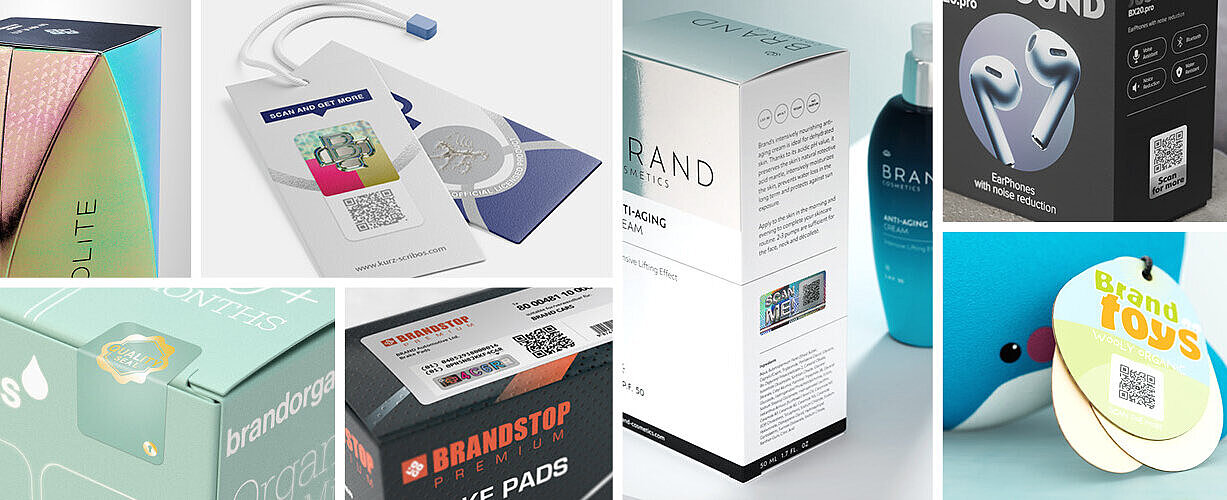
Counterfeiting has evolved into a highly organized, global business. As counterfeiters become faster, more innovative and more professional, brands face a fundamental challenge: protecting products, revenues, brand reputation, and consumers across both physical and digital channels — while managing very different risk scenarios depending on product type, market, price positioning, and distribution model.
This shift has fundamentally changed what an effective anti-counterfeiting strategy must look like.
The requirements of an effective anti-counterfeiting solution
Counterfeiting does not occur at a single point in time or in a single channel. It begins with unauthorized production, continues through physical distribution, and often ends with online resale. Importantly, this affects not only the counterfeit products themselves, but also the security features and markings used to protect them. In many cases, the counterfeit product and the counterfeit security feature originate from different locations and sources and are then assembled in-country, making detection and enforcement significantly more complex.
Many discussions around anti-counterfeiting focus primarily on technologies such as secure QR codes, NFC tags, holograms, blockchain tracking, taggants or forensic markers. While these technologies are valuable, they do not define an effective solution on their own. Solutions that do not address all stages of the product lifecycle inevitably leave blind spots.
As a result, the best anti-counterfeiting solution is no longer defined by a single technology or security feature, but by a complete brand protection strategy.
What defines effectiveness today is whether a solution enables brands to detect, understand, and actively disrupt counterfeiting across physical and digital channels, and ultimately increase the revenue stream of sold original products. In practice, this means an effective anti-counterfeiting solution must deliver these four requirements:
Configuration and Scalability
- Be individually configured to the product, market, risk profile, and price positioning
- Be economically scalable, supporting both high-volume, price-sensitive products and premium or luxury goods
Direct Product Protection
- Protect the product directly through physical security labels or markings
Authentication and Data-Based Insights
- Enable universal consumer authentication via smartphone without app installation, generating sufficient data volume
- Be backed by a digital intelligence platform that analyzes authentication data to identify patterns, sources, and distribution routes
Online Brand Protection and Enforcement
- Be connected to online brand protection, test buys, and enforcement to remove counterfeit offers and disrupt networks.
These requirements can be structured into three core elements that define an effective anti-counterfeiting system.
The Three Core Elements of Any Effective Anti-Counterfeiting System
To function as a system rather than a collection of isolated measures, every effective anti-counterfeiting strategy is built on three core elements.
These elements are not products or technologies — they describe functional roles within a complete system:
- Physical product protection, enabling immediate, on-the-spot authenticity checks
- Digital authentication and data intelligence, transforming individual checks into actionable insights
- Enforcement and online brand protection, removing counterfeit products from the market and disrupting networks
Only when these three elements work together can counterfeiting be detected, analyzed, and actively stopped — rather than merely observed.
Core Element 1: Physical Product Protection
Physical product protection forms the foundation of any anti-counterfeiting system.
Physical security labels or markings protect the product directly and can be applied as labels or integrated into packaging through printing, hot stamping, cold foil, flexo, offset, digital printing, or in-line production processes.
These markings enable all relevant stakeholders to check authenticity:
- Consumers, who need simple and visible cues
- Customs and authorities, who must assess goods quickly
- Brands and investigators, who require reliable physical reference points
Physical security markings create deterrence and enable immediate, on-the-spot verification. Their role, scope, and design depend on the specific product, market and risk scenario.
This is also where individual configuration begins.
Not every product faces the same counterfeiting risk. Volumes, price points, regulatory requirements, and distribution channels differ significantly. As a result, physical product protection must be selected and designed specifically for each product and market.
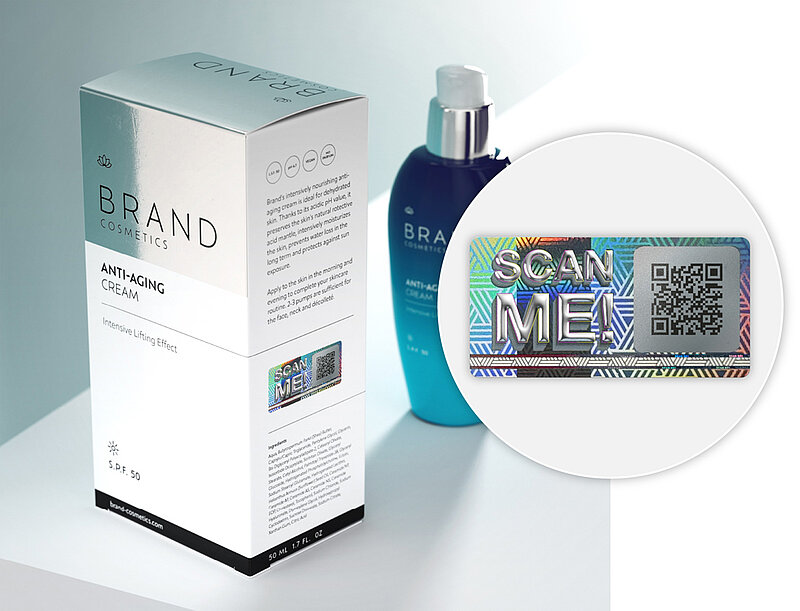
Depending on the use case, protection may rely on purely visual security features, purely digital authentication, or a combination of both within a single label. Visual holographic features support immediate recognition at the point of sale, digital labels enable smartphone-based authentication and data generation, and combined solutions provide both visible trust cues and digital verification.
The KURZ SCRIBOS brand therefore follows a modular approach to physical product protection. Depending on the use case, labels can be designed as purely visual solutions, digital authentication labels, or integrated visual-and-digital combinations.
Core Element 2: Digital Authentication and Data Intelligence
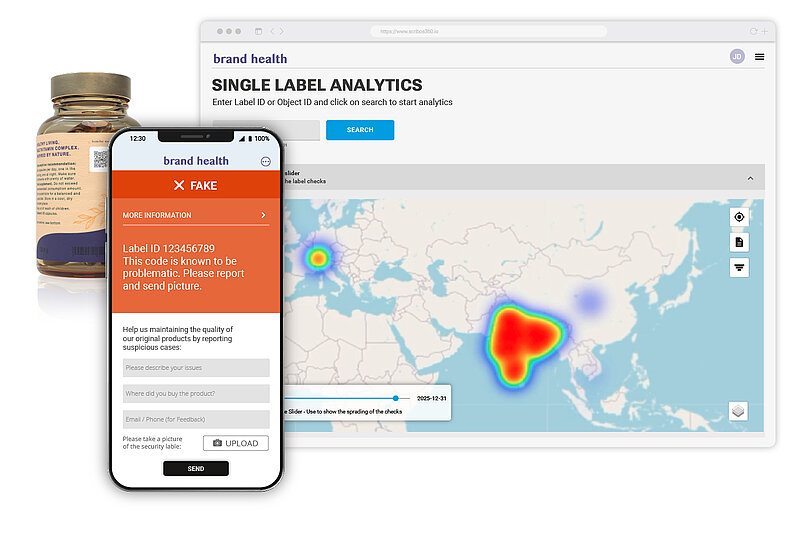
The second core element is digital authentication, which turns individual authenticity checks into structured, analyzable and usable data. Digital security labels, such as secure QR codes, enable smartphone-based authentication without app installation. Verification is fast, simple, and accessible — while simultaneously generating valuable data.
This data allows brands to:
- Enable authentication by everyone, anywhere
- Detect counterfeit hotspots and abnormal scan behavior
- Identify unauthorized production, gray market activity and parallel distribution
- Gain visibility into distribution channels and points of sale
- Distinguish isolated incidents from organized counterfeiting
- Prioritize investigations and enforcement actions
- Generate additional market and marketing insights, such as regional demand differences, enabling brands to take more informed commercial and promotional decisions
KURZ SCRIBOS digital markings support app-free smartphone authentication, ensuring accessibility for consumers and reliable data collection at scale.
Without digital authentication and data intelligence, anti-counterfeiting remains reactive. Identifying individual fakes without identifying their source is a temporary fix, not a sustainable strategy.
Core Element 3: Enforcement and Online Brand Protection
Digital insight only creates value when it leads to action. This makes enforcement and online brand protection the third core element of a complete anti-counterfeiting system.
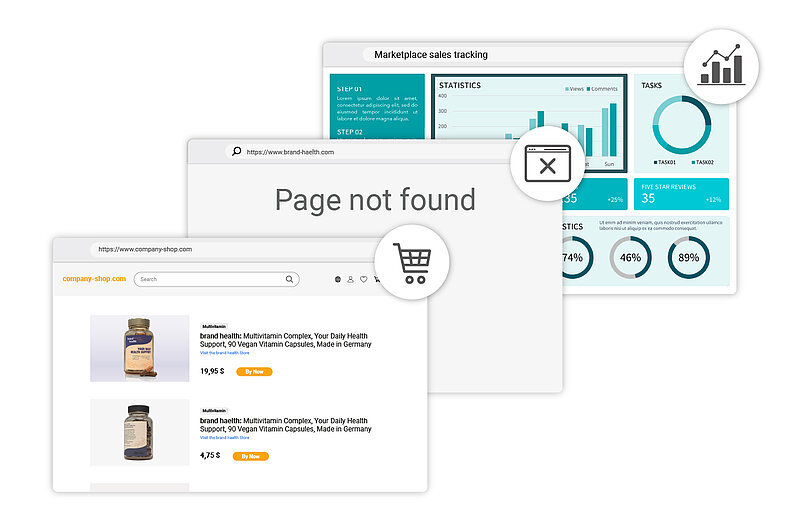
Today, many counterfeit products are sold directly through online marketplaces, social platforms, and unauthorized websites. If anti-counterfeiting efforts stop at the product level, counterfeit activity simply migrates to the most accessible sales channel.
Online brand protection closes this gap by connecting authentication data with:
- Market and platform monitoring
- Investigations and test purchases
- Takedowns and enforcement actions
This ensures that counterfeit offers are actively removed where consumers actually buy — not just identified at the product level.
This closes the loop between product-level protection, digital intelligence, and market-level enforcement.
From Authentication to Intelligence and Enforcement
To connect physical labels, digital authentication, and enforcement into one operational system, a central platform is required.
All KURZ SCRIBOS security solutions can be connected to SCRIBOS 360, our digital brand protection platform, where authentication events are verified, recorded, and analyzed. Individual checks are transformed into intelligence that supports investigations and enforcement.
At the KURZ SCRIBOS brand, this intelligence does not have to remain isolated but can be used directly for online brand protection activities such as monitoring, investigations, test purchases, and takedowns.
This is the difference between detecting counterfeits and stopping counterfeiting.

Industries That Benefit Most from Integrated Anti-Counterfeiting Solutions
End-to-end anti-counterfeiting systems are particularly relevant for industries exposed to high volumes, complex supply chains, or strong brand visibility, including:
- FMCG
- Spirits, wine, and beverages
- Cosmetics and personal care
- Pharmaceuticals
- Chemicals and agrochemicals
- Food supplements
- Automotive parts and spare parts
- Luxury and licensed goods
Turning Strategy into Action
Counterfeiting cannot be solved with isolated measures. Brands that rely on single technologies may detect counterfeit products, but they remain reactive instead of proactive, while also being exposed to repeat abuse.
An individualized, modular anti-counterfeiting system enables brands to move beyond detection. By combining physical security labels, digital authentication with data intelligence, and online brand protection, counterfeit activity can be identified, traced, and actively disrupted at its source.
This approach allows brand protection strategies to evolve over time, adapting to new products, markets, and threat scenarios as counterfeiters change their tactics.
Choosing the Right Anti-Counterfeiting Solution for Your Brand
There is no universal setup that fits every brand. The right anti-counterfeiting solution depends on:
- The product portfolio
- Specific counterfeiting and gray-market risks
- Target groups involved in authentication
- Regulatory and market requirements
Experts at the KURZ SCRIBOS brand support brands from risk assessment and solution design through implementation and ongoing optimization — across physical, digital, and hybrid security labels as well as online brand protection. When internal resources are limited, we also operate and analyze the IT systems on behalf of our clients, turning data into action.
For more than 25 years, KURZ SCRIBOS has been a trusted partner to global brands, delivering proven anti-counterfeiting solutions built on security expertise, technological depth, and long-term reliability.
Contact us to discuss how an individualized anti-counterfeiting solution can be designed for your specific brand, product portfolio, and threat scenario: hello@kurz-scribos.com.
Best Anti-Counterfeiting Solutions
High-Impact FAQ
What is the best anti-counterfeiting solution?
The best anti-counterfeiting solution is an individualized, modular system that combines physical security labels, digital authentication with data intelligence, and online brand protection — and turns insights into concrete enforcement actions.
Why must anti-counterfeiting solutions be individualized?
Counterfeiting risks vary by product, market, volume, and distribution channel. Effective solutions must be tailored to the specific threat scenario and remain adaptable over time.
Are security labels still relevant today?
Yes. Security labels remain the foundation of product protection. When combined with digital authentication and data intelligence, they become scalable brand protection tools. Consumer-enabled authentication is particularly valuable because it generates crowdsourced data that reveals risks internal investigations alone cannot uncover.
Are secure QR codes enough to stop counterfeiting?
Secure QR codes are a critical component of modern anti-counterfeiting solutions, especially for digital authentication. Their full value is realized when they are integrated into a broader system that includes visual security and enforcement.
What is a hybrid security label?
A hybrid security label combines visual authentication with digital verification, enabling immediate trust at the point of sale and deeper, data-driven protection.
Why is data so important in anti-counterfeiting?
Data reveals patterns, sources, and the scale of counterfeiting. Without data, brands can detect counterfeits — but they cannot dismantle counterfeit networks.
How does online brand protection support anti-counterfeiting?
Online brand protection removes counterfeit offers from marketplaces, websites, and social platforms, preventing counterfeit products from reaching consumers.
Which industries need advanced anti-counterfeiting solutions most?
Industries with high volumes, high margins, strong brands, or complex supply chains — such as FMCG, cosmetics, pharmaceuticals, spirits, automotive parts, and luxury goods — benefit most from integrated systems.